
How to Hire Interns Without Screening: The Pre-Vetted Platform Solution
Hiring interns sounds simple – until you actually try to do it.
You have posted an internship position. 100+ applications fill your inbox. You open first resume: vague skill, no portfolio, generic cover letter clearly written by ChatGPT.
You open second: slightly better, but you are not sure if they actually know what they claim to know.
By applicant 15, you realize you will need to spend 20+ hours just to screening resumes before you can even start interview.
For startups with limited time and small teams, manual intern screening becomes a bottleneck.
What if you could skip all of that?
Welcome to the world of pre-vetted intern platforms – where someone else does the hard work of screening, and you only see candidates who are actually qualified.
Can You Really Hire Interns Without Screening?
You can’t hire interns without any screening – but you can eliminate manual resume filtering and repetitive interviews. Smart startups replace traditional screening with structure, filters, and real-work signals.
- Manual resume screening is outdated for intern hiring
- Startups should filter interns using tasks, structure, and systems
- Clear projects matter more than CVs
- Small real-world assignments replace long interviews
- Platforms and processes can reduce screening time by 70 – 80%
Why Traditional Intern Screening Fails Startups
Let’s be honest about what screening really looks like:
Most startups follow this process:
- Post job: 2 hours writing description and posting
- Wait for applications: 1-2 weeks
- Screen 100+ resumes: 15-25 hours
- Conduct first-round video screens: 10-15 hours (assuming 30 candidates at 30 minutes each)
- Second interviews: 8-12 hours (top 10 candidates at 1 hour each)
- Skills assessments: 5-10 hours reviewing work
- Reference checks: 3-5 hours
- Make offer: 1 hour
Total time investment: 45-72 hours
If you lack experienced HR candidates for screening, it will increase the number of hours required for your work.
Why this doesn’t work:
- Resumes are weak predictors at the intern level
- Degrees don’t equal job-ready skills
- Early talent can’t shine on paper alone
- Screening often takes longer than the work itself
When hiring interns, potential matters far more than polish.
The Smarter Alternative: Hire Interns Without Manual Screening
Here’s how modern startups do it.
- Use Virtual Internships
Zero-cost platform funded by universities, with pre-screened talent ready to contribute from day one.
Vetting process:
- University partnerships ensure academic credentials
- Pre-screening for motivation and commitment
- 500+ project templates to match interns to appropriate work
- Built-in support infrastructure
Best for: Startups with limited funds who need immediate help on defined projects.
How it works:
- Post your project needs
- Receive tailored intern recommendations that fit your goals
- Interview recommended candidates
- Bring on qualified interns within days
Cost: Free for companies (university-funded)
Downside: Universities often fund internships, so availability varies by semester.
2. Use Platforms That Pre-Filter Candidates like Ditansource
Smart startups don’t source interns from everywhere.
Vetting process:
- Profile verification for all candidates
- AI-based skill matching aligned with project requirements and cultural fit
- Platforms focused on interns, not job spam
Ditansource best for: Companies wanting both interns AND freelancers on one platform with global reach and fair pricing.
This removes:
- Fake applications
- Low-intent candidates
- Resume flooding
You’re not screening hundreds of random applicants. The platform’s verification means you only see serious, qualified candidates.
3. Start with a Clearly Defined Internship ProjectInstead of screening people, screen the work.Before hiring, define:
- Define your core requirements, including education, experience, and type of work
- Anchor hiring around one core project
- Set 3–5 clear, measurable deliverables
- Define a 30–60 day expected outcome
Example:
“Marketing intern to create 10 SEO blog outlines in 30 days”. When the project is clear, unqualified candidates self-filter out.
4. Replace Resumes With a Simple Task
Resumes tell you where someone studied; tasks show you what they can actually do.
Use a small but real task:
-
- Marketers: Write a sample LinkedIn post
- Designers: Redesign one section of a landing page
Developers: Fix a small bug or write a function keep it:
- Short (1–2 hours max)
- Relevant to real work
- Unpaid or lightly paid (with full transparency)
This single step replaces:
- Resume screening
- Multiple interview rounds
A short, relevant task can replace resumes and multiple interviews – if expectations are clear and transparent.
What You are Really Doing
You are NOT hiring without screening.
You are:
- Screening through real work
- Filtering through structure
- Evaluating through outcomes
This approach is far more reliable for intern hiring.
This isn’t hiring without screening – it’s screening that actually works.
What You Still Need to Do (Screening-Free Doesn’t Mean Effort-Free)
Even with pre-vetted candidates, you still need to:
1. Define Your Requirements Clearly
Pre-vetted platforms need to know what you are looking for.
Requirement must be clear: “Marketing intern to create social media content (Instagram, Facebook), 15-20 hours/week, must have portfolio of personal or school projects, comfortable with Canva and video editing.
2. Conduct Final Interviews
Pre-vetting eliminates Unqualified candidates, but you still need to evaluate:
- Cultural fit with your team
- Communication style compatibility
- Enthusiasm for your specific mission
- Ability to work independently (for remote roles)
Recommended interview structure:
-
- 30-minute video call
- Ask about their interest in your company specifically
- Give them a 10-minute presentation/portfolio walkthrough
- Discuss one small project they’d work on
- Answer their questions
3. Onboard Properly
- Pre-vetted doesn’t mean plug and play. You still need:
- Clear project briefs
- Access to tools and resources
- Assigned mentor or supervisor
- Regular check-ins
The ROI of Pre-Vetted Platforms
- Time Saved:
- Traditional screening: 45-72 hours
- Pre-vetted platform: 5-10 hours (reviewing top matches + interviews)
- Savings: 35-62 hours
- Money Saved:
If your time is worth $100/hour (conservative for founders):
- Traditional screening cost: $4,500-7,200 in opportunity cost
- Pre-vetted platform fee: $200-500 on average
Even with platform fees, you save $4,000-6,700
6. Quality Improvement:
Pre-vetted platforms have expertise in screening that most founders lack. They know:
- Red flags in resumes and portfolios
- What questions reveal true capabilities
- How to assess soft skills remotely
- Industry standards for intern qualifications
Result: Higher quality hires with less effort.
Common Mistakes to Avoid Before Hiring Intern
- Hiring interns without clearly defining the work
- Assigning large, unpaid test tasks
- Expecting interns to perform at freelancer-level speed
- Skipping feedback during trial periods
- Prioritizing speed over clarity
Speed in hiring only works when clear systems are in place.
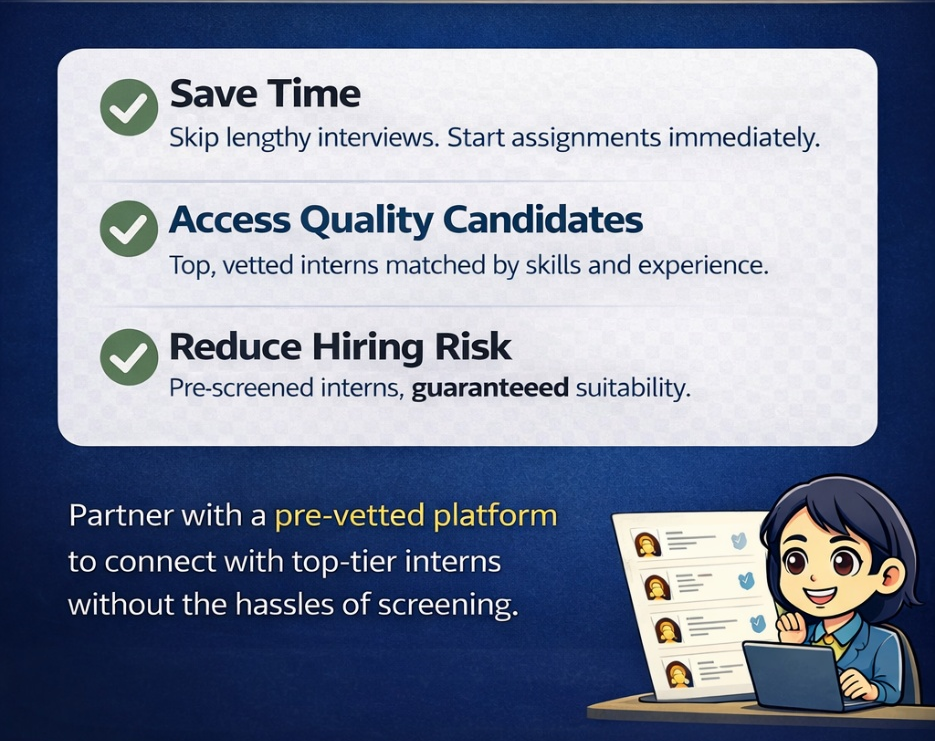
Key Takeaway for Founders
Stop Screening, Start Building
The era of manually screening intern applications is over.
Intern hiring doesn’t fail because interns lack talent – it fails because startups rely on outdated screening methods that don’t work for early-career candidates.
Pre-vetted platforms have professionalized intern hiring, applying the same rigor used in executive recruiting to entry-level talent.
Instead of overvaluing resumes and interviews, successful startups shift their focus to:
- Clear, well-defined projects
- Small, real-world tasks
- Short trial periods
This approach allows you to hire interns faster, make better decisions, and reduce effort on both sides.
The goal isn’t to hire interns without screening.
The goal is to stop wasting time on the wrong kind of screening.
Stop spending 50 hours screening resumes. Start building your team today.